
A
Alt Text (Alternative Text): A brief description of an image. Alt Text is used by search engines and screen readers to know the content of an image and categorize it correctly.
B
Backlink: A link from another website that directs audiences to your site. High-quality backlinks (like from a website like CNN) improve the domain authority (DA) of your website.
Black Hat SEO: Unethical SEO practices (i.e. keyword stuffing) that violate search engine guidelines.
Bounce Rate: This is the percentage of visitors that quickly leave or take no further action (like clicking to another page in the same website, leaving a comment, or adding an item to their cart) after visiting a website.
C
Canonical URL: A tag used to prevent duplicate content issues by specifying the “main” version of a web page.
Scenerio:
Imagine you sell a blue mug on your e-commerce site, and the product is accessible via two URLs:
https://example.com/blue-mughttps://example.com/products?id=123(URL with a tracking parameter)
Both URLs show identical content, which can confuse search engines. Search engines might see it as duplicate content and split ranking signals.
Solution: Add a Canonical Tag
In the HTML <head> section of https://example.com/products?id=123, you’d add html as follows:
<link rel=“canonical” href=”https://example.com/blue-widget” />
This tells search engines:
“Treat /products?id=123 as a copy of /blue-widget. Only count links and rankings for the canonical version.”
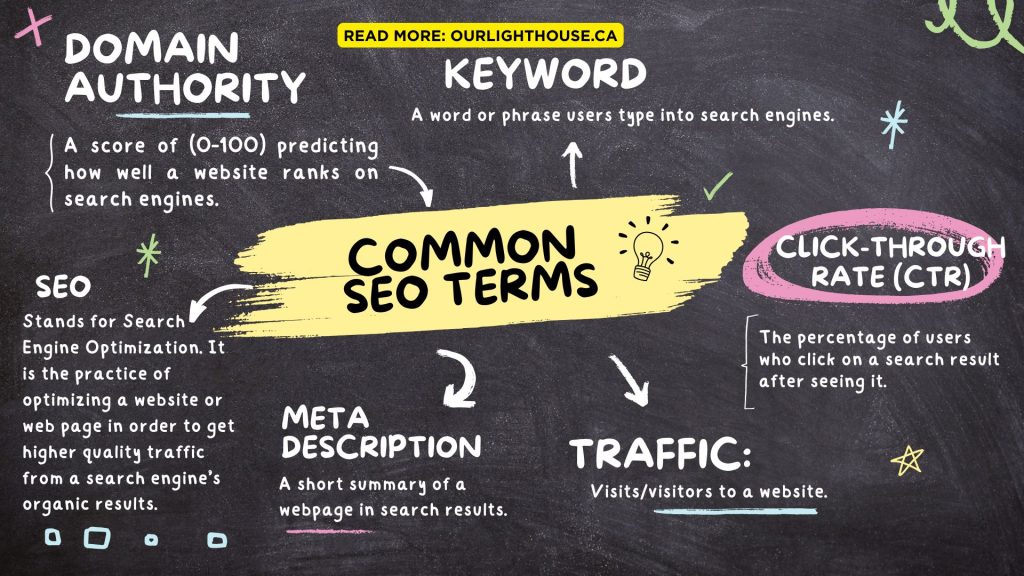
Click-Through Rate (CTR): The percentage of users who click on a search result after seeing it.
Conversion: A term that is used to describe what occurs when a browser completes a desired action on a website or digital platform, turning them from a visitor into an engaged lead, customer, or supporter.
D
Domain Authority (DA): A score (0-100) predicting how well a website ranks on search engines.

Duplicate Content: Identical or very similar content on multiple pages, which can harm rankings.
E
Evergreen Content: Content that will always remains relevant over a long period of time (i.e. “How to Tie a Tie”).
F
Featured Snippet: A highlighted answer box that is displayed at the top of Google’s search results.

H
Header Tags (H1, H2, H3, etc.): HTML tags used to structure content. H1 is the main title.
High Intent Buyers: Browsers actively searching for solutions on search engines and that have a strong likelihood of conversion (i.e. purchasing a product).
I
Intent-Driven Phrases: Search queries with keywords that reveal a browser’s goal (i.e, “cost of New Balance 530 sneakers”. This signals an intent to purchase the sneakers).
K
Keyword: A word or phrase users type into search engines.
Keyword Density: The percentage of times a keyword appears on a page (avoid overuse).
Keyword Research: The process of finding high-value keywords.
Keyword Stuffing: Repeating the same keywords (or similar phrases) in content in order to try to manipulate rankings.
L
Link Building: This is the process of getting other websites to link their content to your website. This improves a website’s rankings (DA).
Long Tail Keywords: Longer, more specific keywords entered into search engines (i.e. “best running shoes for narrow feet”).
M
Meta Description: A short summary of a webpage in search results (affects CTR).
Mobile First Indexing: The process in which Google primarily uses the mobile version of a site for rankings.
O
On Page SEO: Optimizing elements on a webpage (i.e. content, headers, meta tags) for search engine discovery and higher ranking.
Off Page SEO: The process of optimizing external factors (such as backlinks, website loading time, etc) for search engine discovery and higher ranking.
P
Page Speed: The speed in which a webpage/website loads.
R
Robots.txt: A file telling search engines which pages to crawl or ignore.
S
SEO: Stands for Search Engine Optimization. It is the practice of optimizing a website or web page in order to get higher quality traffic from a search engine’s organic results.
SEO Audit: The process of evaluating a website to see how well it performs in search engines.
Search Engine Results Page (SERP) – The page on a search engine that displays search results.
Sitemap – A file listing all important pages for search engines to crawl.
T
Title Tag: The clickable headline in search results.
Traffic: Visits/visitors to a website.
U
URL Slug: The part of a URL that comes after the domain (i.e. https://ourlighthouse.ca/blog/).
User Experience (UX): How visitors interact with a site. For example, a website with a poor UX will have a high bounce rate, affecting a website’s ranking on search engines.
W
White Hat SEO: Ethical SEO practices following search engine guidelines.